
Actividades
What the Blue Zones Can Teach Us About How to Live Better
Traducir artículo
¿Quieres un resumen de este artículo?
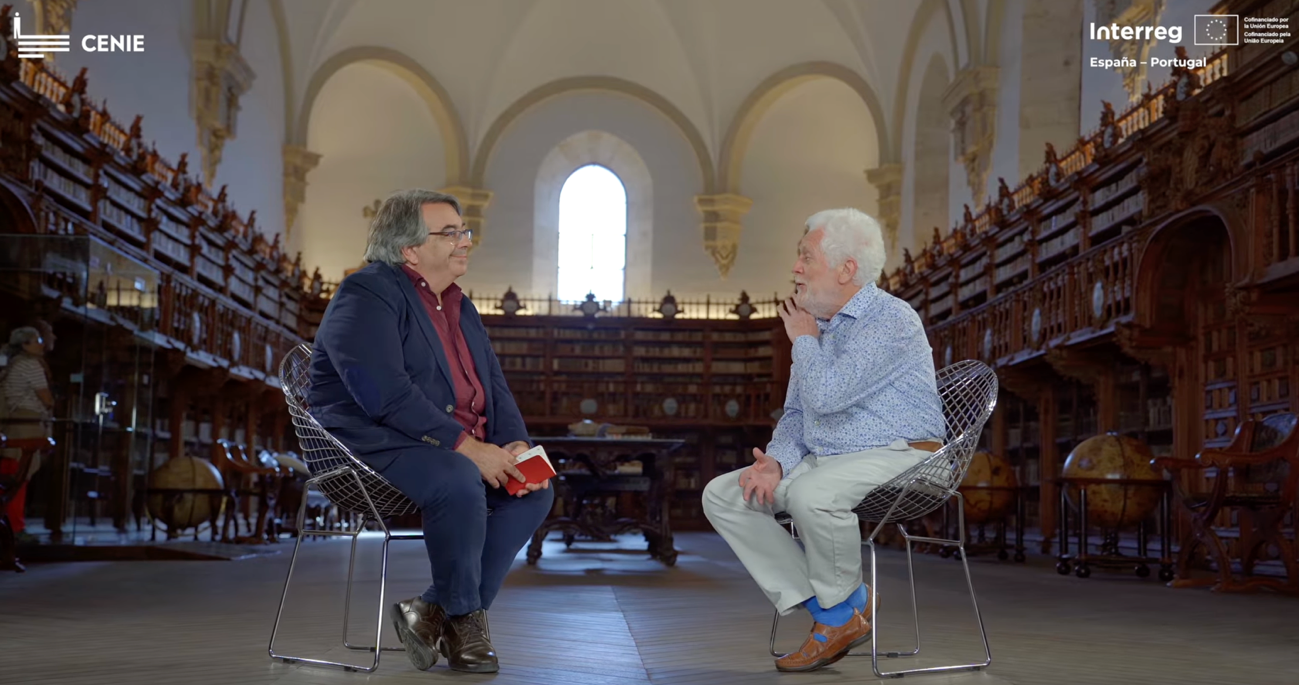
The General Foundation of the University of Salamanca, through the International Centre on Ageing (CENIE), presents a new episode of its series Conversations in Salamanca, titled Understanding Longevity. On this occasion, the conversation brings together Michel Poulain, Belgian demographer and co‑creator of the Blue Zones concept, and journalist and writer Jesús Ruiz Mantilla.
This is not simply a conversation about why some people live longer. What it offers is something far more interesting: an accessible and well‑guided reflection on the conditions that help us live better—with more health, more meaning and stronger connections with others. From the outset, the dialogue avoids grandiose tones and opts for something much more useful: bringing into everyday life some of the lessons that have emerged from observing exceptionally long‑lived communities.
Michel Poulain and the cartography of longevity
Michel Poulain is one of the essential figures for understanding how contemporary research on longevity has evolved. In the early 2000s, while conducting research in Sardinia, he identified areas where the presence of centenarians—especially men—was extraordinarily high. To mark them on his maps, he used blue ink. From there emerged an expression that would later gain international recognition: the Blue Zones. This observation was later extended to other regions such as Okinawa, Nicoya and Ikaria, reinforcing a decisive idea: longevity does not depend solely on genetics, but also on living environments, sustained habits and forms of social organisation.
This is precisely one of the audiovisual piece’s great strengths: Poulain does not present longevity as a mystery reserved for a select few, but as a reality that can be analysed, understood and, to some extent, cultivated. His contribution is valuable because it combines expert knowledge with a clear and approachable way of explaining it. And Ruiz Mantilla, acting as an excellent host, fulfils the role of mediator: he brings forward the questions that many viewers might ask themselves from their own experience.
Seven key ideas worth taking seriously
One of the most useful moments in the conversation comes when Poulain summarises, in several practical insights, some of the traits shared by the longest‑lived communities. These are not miracle recipes or empty promises. They are simple yet deeply revealing guidelines, because they point toward a more balanced and coherent way of living.
The first has to do with food: not trendy diets, but fresh, local, seasonal ingredients and a more moderate relationship with eating. The second concerns everyday movement: walking, climbing stairs, tending a garden or staying active without turning exercise into an obsession. The third highlights the importance of rest and stress reduction—two dimensions that are far too undervalued in societies that have mistaken speed for progress.
From there, the conversation shifts to an especially meaningful dimension: social bonds. Poulain emphasises the weight of family, neighbourhood, friendship and the sense of belonging. Not as a moral ornament, but as a real factor of wellbeing. Added to this is the relationship with one’s environment and, finally, the need to maintain a purpose—a reason to get up each morning with some sense of direction.
What matters, moreover, is that these ideas do not operate in isolation. This is one of the most interesting nuances of the dialogue. It is not enough to eat better if one lives in isolation. It is not enough to walk if everything else is marked by stress, haste or emotional disconnection. Longevity appears here not as a collection of tricks, but as a kind of harmony between body, time, community and meaning.
The city can learn too
Another strength of the conversation is that it does not idealise the places observed. Poulain does not suggest turning Sardinia or Ikaria into exotic postcards impossible to replicate. What he raises—and this is where the dialogue gains real force—is whether that philosophy can be brought into urban environments, into our neighbourhoods and our real routines.
The answer is not to flee the city, but to ask ourselves what kind of urban life we are building. More green spaces, more shared time, more opportunities to walk, more conversation, less submission to the clock and to permanent anxiety: that is a concrete agenda. And behind it lies an uncomfortable but true idea: many contemporary problems stem not only from how we age, but from how we are living.
A conversation fully aligned with New Long‑Lived Societies
The discussion is part of the New Long‑Lived Societies project, promoted by the General Foundation of the University of Salamanca, the Polytechnic Institute of Bragança and the Economic and Social Councils of Spain and Portugal. In this framework, longevity is not approached as a burden, but as a historical transformation that demands new perspectives, new policies and new forms of coexistence.
This alignment matters. The value of the audiovisual piece lies not only in disseminating findings about the Blue Zones, but in placing them within a broader conversation: how to build societies capable of making better use of accumulated talent, strengthening social participation and responding intelligently to demographic change. That is why it works: because it does not merely inform—it helps us think.
It is also worth emphasising something essential. Longevity is not an issue that begins when a person reaches a certain age. It concerns us earlier: in how we organise work, rest, care, community life, urban planning and intergenerational relationships. Seen this way, the conversation does not speak only to those who are ageing today, but to all of us.
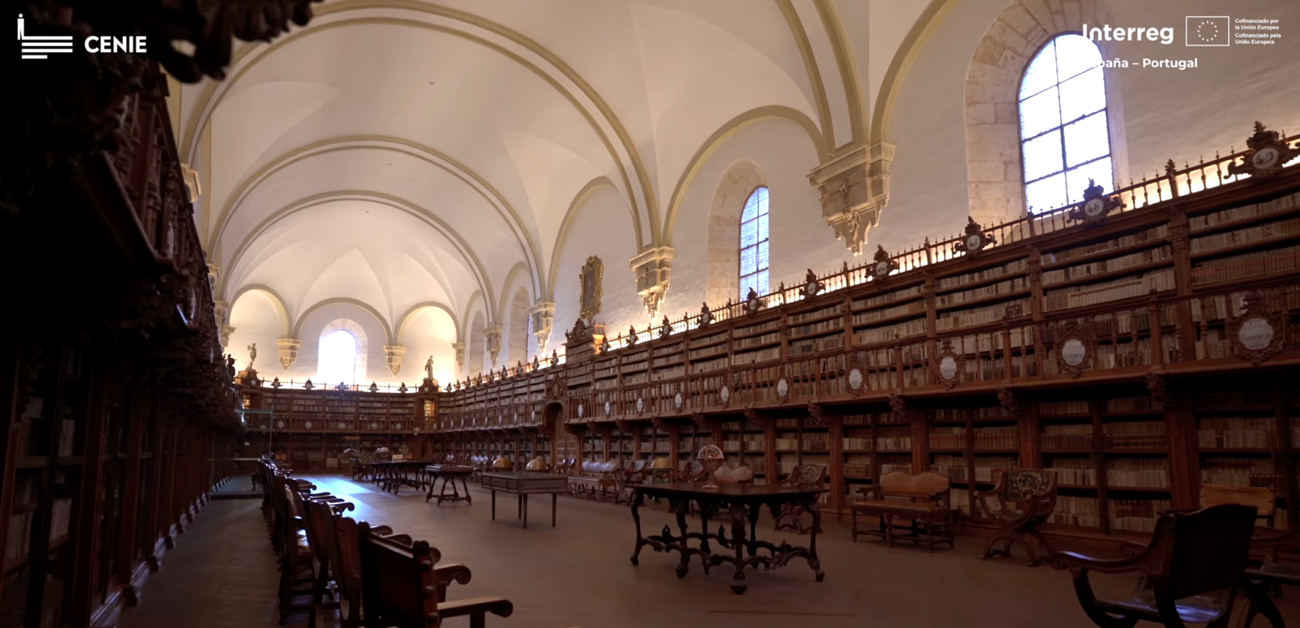
Historic Library of the University of Salamanca
A useful piece for research and public debate
The conversation also leaves us with fertile questions. Are there communities in the Iberian Peninsula whose ways of life offer comparable lessons? Which elements of the Blue Zones can be adapted to different contexts marked by inequality, territorial dispersion or fragile social bonds? How can these insights be translated into public policies, community practices or local wellbeing strategies?
This is where the audiovisual piece transcends its format. It is useful because it offers recognisable and applicable insights. It opens a path of reflection for researchers, public officials and territorial actors interested in understanding what makes a healthier, more integrated and more fulfilling life possible.
Longevity as a shared task
The conversation between Michel Poulain and Jesús Ruiz Mantilla does not offer magic formulas — and that is precisely why it is valuable. What it proposes is something more serious: an invitation to view longevity not as a biological accident or a commercial promise, but as a daily construction shaped by habits, environments and social bonds.
Perhaps this is where the most fertile idea lies: longevity does not begin when we grow old, but much earlier, in the way we choose to live, coexist and care. And that, more than a lesson about distant territories, is a question addressed to us.
Conversations in Salamanca: understanding longevity is part of the New Long-Lived Societies project, co‑funded by the European Union under INTERREG, the Spain‑Portugal Cooperation Programme, POCTEP 2021‑2027.
¿Quieres que te recomendemos más artículos en base a tus lecturas anteriores?