
Actividades
IBERLONGEVA presents to the Commissioner of the PERTE Vanguard Health its Iberian commitment to meaningful longevity
Traducir artículo
¿Quieres un resumen de este artículo?
The CENIE shared in Salamanca the scope of IBERLONGEVA, OLAS and Territory of Well‑Being, a cross‑border cooperation initiative between Spain and Portugal aimed at generating applicable science to preserve autonomy, activate territories and promote healthy longevity.
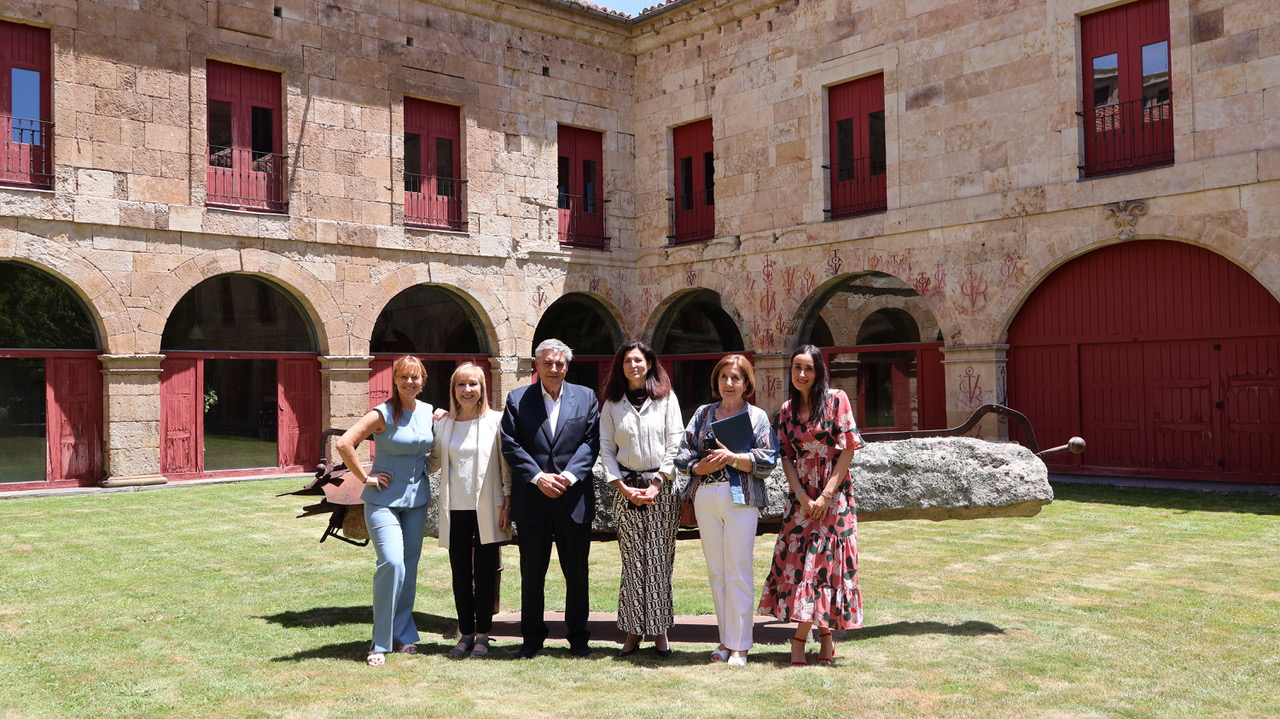
The International Centre on Ageing (CENIE) held an institutional meeting in Salamanca with representatives of the PERTE Vanguard Health, where the progress of IBERLONGEVA, its evolution into OLAS — Observatory for Active and Meaningful Longevity —, and the concept of Territory of Well‑Being were presented.
IBERLONGEVA is a cross‑border cooperation initiative between Spain and Portugal, promoted by the University of Salamanca, the University of Vigo and the Polytechnic Institute of Bragança, with the participation of CENIE. The project, approved under the Interreg VI‑A Spain–Portugal Programme — POCTEP — 2021–2027, is co‑financed by the European Union through the European Regional Development Fund (ERDF). This Iberian and European dimension is particularly relevant, as it positions healthy longevity not only as a health or demographic challenge, but also as a field of scientific cooperation, territorial innovation and social cohesion.
The meeting was attended by Raquel Yotti, Commissioner of PERTE Vanguard Health; Rosa María López Alonso, Deputy Government Delegate in the province of Salamanca; Lucía Martínez Adrián, Head of Communications of the Commissioner’s Office; and Raquel Hernández Delgado, advisor at the CRED – Reference Centre for Data Spaces of the Directorate‑General for Data (Ministry for Digital Transformation and Public Administration). Representing CENIE were Juan Martín, Director of the Centre, and Mónica de la Fuente, CENIE researcher.
The presence of the Commissioner of PERTE Vanguard Health gave the meeting special institutional relevance. It made it possible to directly share the scope of an initiative that CENIE has been promoting together with its Iberian academic partners around one of the great challenges of our time: how to turn longevity into an opportunity for health, prevention, innovation, the care economy and territorial rebalancing.
During the meeting, the document “IBERLONGEVA, OLAS and Territory of Well‑Being. Iberian infrastructure for research, data and prevention for healthy longevity and territorial rebalancing based on science” was presented. It was prepared to structure the scientific, technological and institutional vision of the project. The document synthesises a central idea: IBERLONGEVA should not be understood as an isolated survey; OLAS should not be conceived as a simple data repository; and Territory of Well‑Being is not a territorial label, but the translation of evidence into prevention, services, innovation, the care economy and cohesion.
IBERLONGEVA starts from a simple but decisive observation: living longer does not necessarily mean living better. The real challenge for long‑lived societies is to preserve autonomy, functional capacity, emotional well‑being, social participation and the possibility of ageing meaningfully in one’s own environment. For this reason, the project works with a multidimensional reading of ageing, integrating social, physical, mental, functional, clinical, biological, economic and territorial factors.
The initiative is being developed in three territories of high demographic relevance: Zamora, Ourense and Bragança. These areas make it possible to analyse ageing in urban, rural and mixed contexts, where longevity is not a statistical abstraction but a daily reality that challenges health systems, social services, community networks, housing, mobility, care and the local economy.
One of the distinctive values of IBERLONGEVA is its measurement ecosystem. SOCI‑LONGEVA provides the social dimension of the project, collecting information on living conditions, cohabitation, support networks, participation, housing, environment, economic resources, loneliness and subjective health. This layer is essential to understand that many trajectories of loss of autonomy cannot be explained solely from the clinical consultation, but also from the home, the neighbourhood, the support network, economic capacity or the real availability of services.
To this dimension is added MENFIS‑LONGEVA, focused on physical, mental and functional health. This module incorporates variables related to sleep and circadian rhythms, perceived stress, anxiety, depression, resilience, nutrition, physical activity, frailty, cognition and social perceptions of ageing. Its relevance lies in the fact that many of these factors are modifiable and can therefore guide prevention strategies, community interventions and the promotion of healthier longevity.
The document also foresees the progressive incorporation of clinical and functional parameters and biomarkers, as well as new dimensions such as biological age and subjective financial well‑being. Biological age can provide a complementary measure of real physiological ageing, while subjective financial well‑being helps explain how security, control and economic peace of mind influence health, stress, habits, adherence to preventive recommendations and the possibility of ageing at home.
In this context, OLAS — Observatory for Active and Meaningful Longevity — is conceived as the infrastructure that will make it possible to transform data into applicable knowledge. It is not about accumulating information, but about organising data, ensuring their quality, integrating them securely, analysing them with transparent methodologies and returning useful knowledge to researchers, professionals, administrations and citizens.
Its potential unfolds at several scales. At the community level, OLAS can help identify vulnerability profiles, territorial needs, inequalities and opportunities for preventive intervention. At the personalised level, it can contribute to guiding supervised preventive pathways, always with criteria of validation, explainability, data protection and professional responsibility. In the medium term, it also opens the door to responsible predictive models and digital twins, understood as support tools to simulate scenarios, prioritise resources and better evaluate interventions — never as substitutes for clinical or social decision‑making.
The concept of Territory of Well‑Being expands this logic and projects it onto territorial development. Longevity ceases to be understood only as care pressure or demographic challenge and becomes a health, social, economic and scientific asset. A long‑lived territory can also be a territory of innovation, proximity services, care economy, skilled employment, applied research and cohesion. This perspective connects health and territorial development, placing prevention and well‑being as drivers of rebalancing and transformation.
The meeting held in Salamanca made it possible to explain this vision in depth and to share a working architecture that connects applied science, preventive health, data governance, responsible artificial intelligence, community care and territorial cooperation. The impressions received afterwards confirmed the positive institutional reception of the initiative, the interest generated by the information shared and the willingness to keep the dialogue open for future collaboration opportunities.
IBERLONGEVA, OLAS and Territory of Well‑Being thus represent a commitment to a science capable of looking at ageing with rigour but also with foresight. A science that does not settle for describing the challenges of long‑lived societies, but works to turn them into opportunities for health, autonomy, well‑being and cohesion.
With this initiative, CENIE reaffirms its commitment to a vision of longevity not as a passive destiny, but as a field of innovation, cooperation and public responsibility. Preserving autonomy, preventing frailty processes and activating territories through evidence form the core of a proposal that aims to generate applicable knowledge where life unfolds: in bodies, homes, communities and territories.
¿Quieres que te recomendemos más artículos en base a tus lecturas anteriores?