The Overload of Grandparenthood
Traducir artículo
¿Quieres un resumen de este artículo?
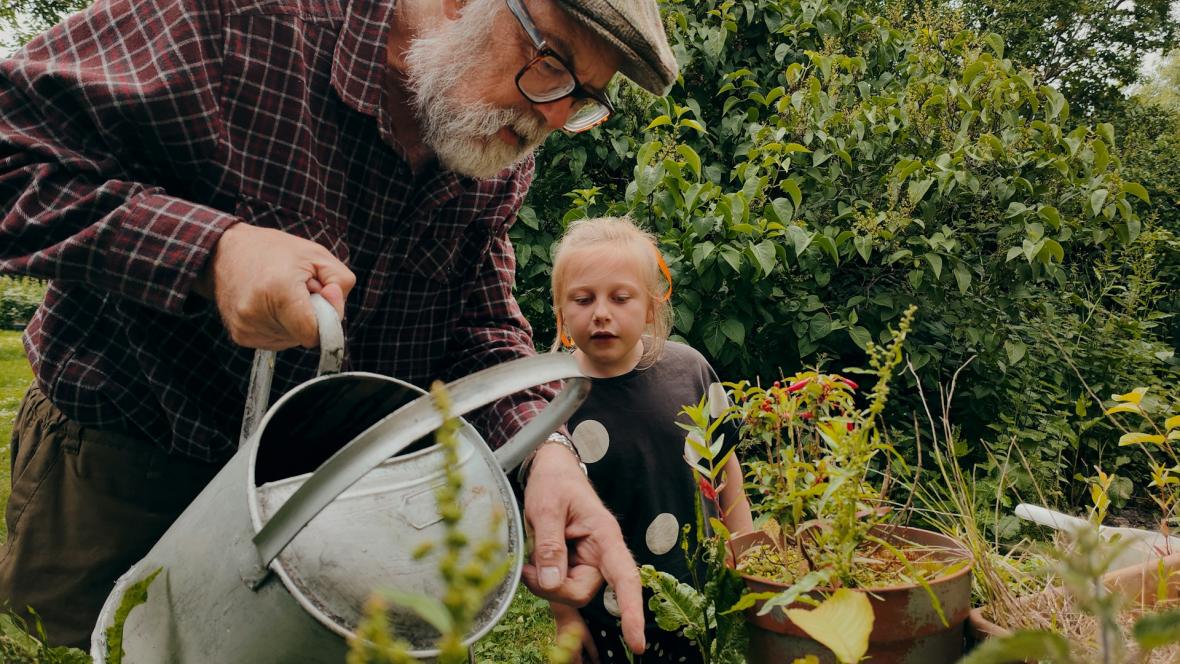
Sometimes grandparenthood seems to be equated with old age, even for those who never had children. In these visions, grandparenthood (something that happens to you, that you may or may not desire, but over which you have no control) is presented as a stage of fulfillment, of tenderness, and of transmission of experiences, of life stories. Of love. We frame it so idyllically that we imagine grandmothers knitting sweaters while baking some delicious cake and, if we’re not careful, making homemade soap that (I imagine) they stir with a free foot. Precious and devoted forms of grandparenthood, full, which nevertheless do not encompass, by any means, all the profiles of grandparenthood or the different degrees of involvement that are desired and desirable.
I know of absent, diffuse forms of grandparenthood, of those who run away from their grandchildren or do not recognize them as constitutive parts of their being, just as I know of mothers who at some point turn the page on their children. The manifestations of love and of family relationships are infinite and different, even though we insist on putting them into a box of uniformity that prevents us from understanding situations and experiences. How little we actually know about the lives of others.
If there are forms of grandparenthood that are almost non-existent or elusive, there are also forms of grandparenthood that are synonymous with overload. Of people who already accumulate years and tasks that never end. Because for some people (women) who are caring for children —which rarely ends completely— later on, the care of grandchildren is added. I am talking about active care, the kind that constitutes the basis of the life of others and that is essential for their survival. Even for the survival of the economic system.
Some of these devoted grandparents also care for their own fathers or mothers, already nonagenarians. Very old people, who in turn are cared for by other people who are also old, often women who have already surpassed the legal retirement age. In that vital interweaving (caring for those above and those below), there also comes, at some point, the care of partners, with lower life expectancy, with chronic illnesses or with dependency. And thus, old age —which we so often imagine as a retreat or a pause— becomes, for many people, a new peak of sometimes overwhelming responsibilities.
Care tasks are complex and have a physical and emotional cost. They are not limited to “keeping company” or “lending a hand.” They demand presence, availability, strength. They demand a constant mental load: knowing which medications are due today, keeping track of medical appointments, managing school troubles, making healthy meals, picking up and dropping off. To this is often added the logistical cost of mobility: long journeys on public transport or by car, spending hours commuting on public transportation just to reach the home where help is needed, juggling impossible schedules. These are not “natural” tasks, even if they are normalized. It is work. Unpaid, invisible, almost always feminized work, and often imposed. Imposed by others, by the custom of caregiving, by the needs of those we love.
As I have pointed out in previous posts, population aging is usually approached from an economic perspective. There is much talk about the sustainability of pensions, health care costs, dependency (wrongly associated exclusively with age). Much less is explored, spoken of, or researched about what it means to live longer years from a relational, emotional, political perspective. As I insist, the increase in life expectancy is, in reality, a social victory. But how do we organize those added years? Or, better said, how do we give content and meaning to those years we have gained?
One of the ways in which it is organized, sometimes from the outside, by the very system that forces us to contribute in multiple ways, is through family care. And here comes into play the figure or identity (created?) of grandparents, and especially grandmothers. Grandparenthood, or as some have wanted to call it, “grandolescence,” is an unchosen stage (one can decide to be a mother or father, but a grandmother or grandfather is something you become, usually without being asked) and one that has been redefined by demographic changes: we live longer, therefore, we are grandparents for longer; we have fewer children, therefore fewer grandchildren receive more attention from more grandparents over more years. That is: more intensity, more dedication, more wear… and many times, less recognition.
Research on grandparenthood has grown in recent years, especially since the 2008 crisis. The focus has been on how the care of grandchildren allows mothers —and sometimes fathers— to remain employed. The crucial role of maternal grandmothers has been underlined in that precarious balance between work and family, in a society that has not resolved its debt with reconciliation. Caring for grandchildren thus becomes the invisible link that sustains the productivity of the intermediate generations. A private, silent support that replaces the dismantling or insufficiency of public support (despite recent achievements).
In Europe, 21% of grandparents care for their grandchildren several days a week. In Spain, that percentage rises to 32%. Sometimes they do it gladly, of course. But not always. The “enslaved grandmother syndrome” is not an anecdote: it is the reflection of a structural inequality that continues throughout life. It is the exhaustion of those who feel they no longer have time for themselves, who cannot attend to their own illnesses or interests, who carry a responsibility without having either the legal authority or the social recognition that would correspond.
Full-time caregiving is not the same as “being nearby.” And sometimes geographical closeness does not necessarily translate into emotional closeness, but it does mean unlimited availability. Some older people end up abandoning hobbies, social groups, rest time, or even medical treatments in order to fulfill what is expected of them as grandparents. Other times they do it joyfully, but even so, that does not erase the effort.
The relationship between grandparents and grandchildren is valuable, without a doubt. It strengthens the emotional development of children, transmits history, identity, continuity. But like any relationship, it needs conditions: shared time, recognition, respect for boundaries, institutional support. Otherwise, grandparenthood runs the risk of becoming a form of sweet exploitation, disguised as unconditional love.
What if we begin to think of old age not as a stage without needs, but as a moment with rights? What if we recognize that even in grandparenthood there are inequalities —of class, of gender, of health— that should matter to us? What if we ask ourselves why so many caregiving tasks always fall on the same bodies, on the same shoulders, throughout life?
Grandfathers and grandmothers are an emotional, practical, and economic safety net for many families. But we cannot continue to base the sustainability of well-being on their overload. We need to recognize, redistribute, and care for caregiving. And also care for those who, after a whole lifetime of caregiving, are still doing it.
¿Quieres que te recomendemos más artículos en base a tus lecturas anteriores?