
Actividades
Reinventing the Time of Work: Nicholas Barr’s Message that Challenges the 21st Century
Traducir artículo
¿Quieres un resumen de este artículo?
There are ideas that not only interpret reality: they change it.
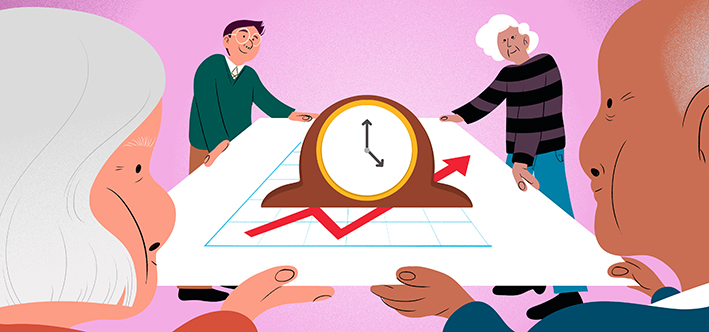
Among the great debates opened by longevity — health, care, pensions, education — one stands out for its urgency and civilizational scope: how to reimagine the time of work in societies that live longer than ever.
Economist Nicholas Barr, professor at the London School of Economics, has devoted much of his career to answering that question. His recent analysis, published in 2025 and disseminated by CENIE, has been one of the most cited and debated texts of the year. Not only for its economic precision, but because it puts into words what defines this new era of longevity: the need for a social contract that redistributes time differently.
A society that no longer fits the old clocks
Barr starts from an undeniable fact: in developed countries, a 20‑year‑old today has more than a 50% chance of living to 100.
But welfare and employment systems remain anchored in the last century, with fixed retirement ages and career paths designed for much shorter lives. “If we live longer but work the same — Barr states — the balances break.”
The challenge is not only financial — how to pay longer pensions —; it is cultural, ethical, and productive. The author proposes an idea as simple as it is radical: time must be distributed differently.
More lifelong learning, more flexibility to work and rest, more opportunities to start again.
In a society where longevity multiplies, work can no longer be understood as a straight line, but as a cycle reconfigured by experience.
Retirement: from end point to life transition
Retirement, Barr reminds us, was a 19th‑century invention: a mechanism to remove from work those who, at 65, were already ill or exhausted.
Today, age has lost that meaning. A woman or man of 70 can remain active, contribute value, teach, create.
That is why Barr advocates replacing the idea of retirement as an end with that of life transition: a flexible, gradual, even reversible step.
Sweden and Norway already apply it: they allow people to receive part of their pension while continuing to work. It is not an economic concession, but a conquest of freedom.
A policy that recognizes diversity: that not everyone arrives the same way, with the same health, or the same desire to continue or stop.
And that aging, far from being an obstacle, can become a new form of productive and personal fulfillment.
The value of experience: why we need older workers
One of Barr’s most powerful statements dismantles one of the most entrenched prejudices: the idea that aging diminishes the value of work.
For the economist, older workers are necessary, but also valuable.
Their contribution is measured not only in productivity, but in emotional intelligence, collaborative leadership, and the ability to connect generations.
While artificial intelligence replaces mechanical tasks, older people bring what no machine can reproduce: empathy, intuition, memory of change.
“Longevity — says Barr — is not a problem to be financed, but a talent to be integrated.” Hence age diversity is not only a matter of justice, but of competitiveness and prosperity.
Flexibility, equity, purpose: the three pillars of a new work culture
Barr’s message is not limited to proposing later retirement.
He speaks of a paradigm shift.
Of replacing rigidity with choice.
Of building systems that do not punish those who want to keep contributing, nor forget those who cannot.
His proposals — gradual and fair raising of the pension age, partial pensions, early access for those who started earlier or suffer chronic illness, lifelong training, adaptation of the work environment — form a roadmap for governments and companies.
An economy that learns to adapt work to the life cycle, and not the other way around.
But his deepest message is political and human: working longer should not be seen as an obligation, but as an opportunity to choose meaningfully how to live the second half of life.
Why this message matters to CENIE
Nicholas Barr’s analysis has become one of the intellectual milestones of the year for CENIE because it embodies the vision that runs through all its projects: longevity as a structural transformation of our societies, not as a demographic phenomenon to be managed defensively.
Talking about work in the age of longevity is talking about how to redistribute life.
About how to combine progress, justice, and well‑being in a time that, for the first time, we have in abundance.
CENIE has placed this reflection at the center of its 2025 agenda because it redefines the public conversation: it is no longer about how much aging costs, but about what we can build with the years we have gained.
The legacy of Barr’s thought
In a century where life expectancy will continue to grow, his message is as technical as it is inspiring: “Work time is also life time. And if we learn to manage it with justice, longevity will cease to be a challenge and become a shared opportunity.”
That is why this text occupies a central place among CENIE’s Highlights of the Year: because it synthesizes, with rigor and vision, an idea that will shape the immediate future of our policies, our companies, and our biographies.
Longevity demands rethinking schedules, trajectories, and endings.
And Nicholas Barr’s thought reminds us that doing so is not a threat, but a promise: the promise of building societies capable of turning time into well‑being.
¿Quieres que te recomendemos más artículos en base a tus lecturas anteriores?