
Humor and Old Age: Laughing at Time Without Ridiculing It
Traducir artículo
¿Quieres un resumen de este artículo?
Time takes itself very seriously… until someone learns to laugh at it. Growing old with humor is an art of survival: it turns aches into anecdotes, forgetfulness into jokes, and age into an invisible medal.
Laughter as Resistance
Humor is one of the most refined forms of intelligence. It allows us to look at reality with distance, without denying it. In old age, that distance becomes wisdom. Those who have lived a long life have learned to laugh even at what once worried them. The body changes, society sometimes excludes, but humor restores power: it is the most elegant way to remain present.
Henri Bergson wrote that “laughter is a social correction with a smile on the lips.” Applied to old age, it could mean that humor does not deny the passage of time but softens it: it teaches us to live with it without resignation or drama. Laughing is, in a way, a form of preserving dignity.
And while medicine strives to prolong life, humor expands it. It allows us to gain inner space, air out our memory, and lighten the weight of time. Aging with humor is also a way of exercising freedom: the freedom not to be trapped by solemnity or complaint.
Between Irony and Tenderness
For decades, popular culture has portrayed older people as caricatures: the absent-minded grandfather, the grumpy neighbor, clumsiness turned into a joke. That easy humor has aged poorly. Laughing at old age is different from laughing with it. The first excludes; the second humanizes.
Chaplin understood this better than anyone: his Charlot aged in every film, but never lost the grace of someone who stumbles without completely falling. The same happens with Quino’s characters, with the biting irony of Woody Allen, or with Mario Benedetti, who wrote: “Laugh, but don’t forget to take laughter seriously.” In all of them, humor is an act of tenderness: a way of sustaining life even when everything seems to lean toward the absurd.
Laughing in old age is not frivolity; it is a form of lucidity. It means recognizing that time passes, that the body changes, but that consciousness —that spark that allows us to grasp the irony of existence— remains alive.
Humor as Medicine (Without Prescription)
Numerous studies confirm that humor has real effects on physical and mental health. Research from the University College of London and the Mayo Clinic shows that people with a sense of humor have lower rates of cardiovascular disease, greater resilience, and stronger social ties. Laughter is contagious, but it’s also protective.
In community programs with older adults, humor workshops have proven to be more effective than many treatments against loneliness. Laughter, when shared, creates invisible bonds: it breaks isolation, reduces anxiety, and restores the individual’s place within the group.
Perhaps that’s why so many older people repeat the same phrase: “If I don’t laugh, I’ll die.” It’s not a joke; it’s a lesson in survival.
Laughing at Time, Not at People
Laughing at time is not defying it; it’s making peace with it. Older people who keep their sense of humor don’t do so because they ignore reality, but because they’ve learned that laughter is also a form of resistance. Well-used irony is an act of moral elegance: a reminder that time may bend us, but it doesn’t break us.
American writer Nora Ephron said that the secret to aging was “to take yourself less seriously.” And she was right: laughter doesn’t diminish life; it gives it back to us. In a world obsessed with looking young, humor is a form of quiet rebellion.
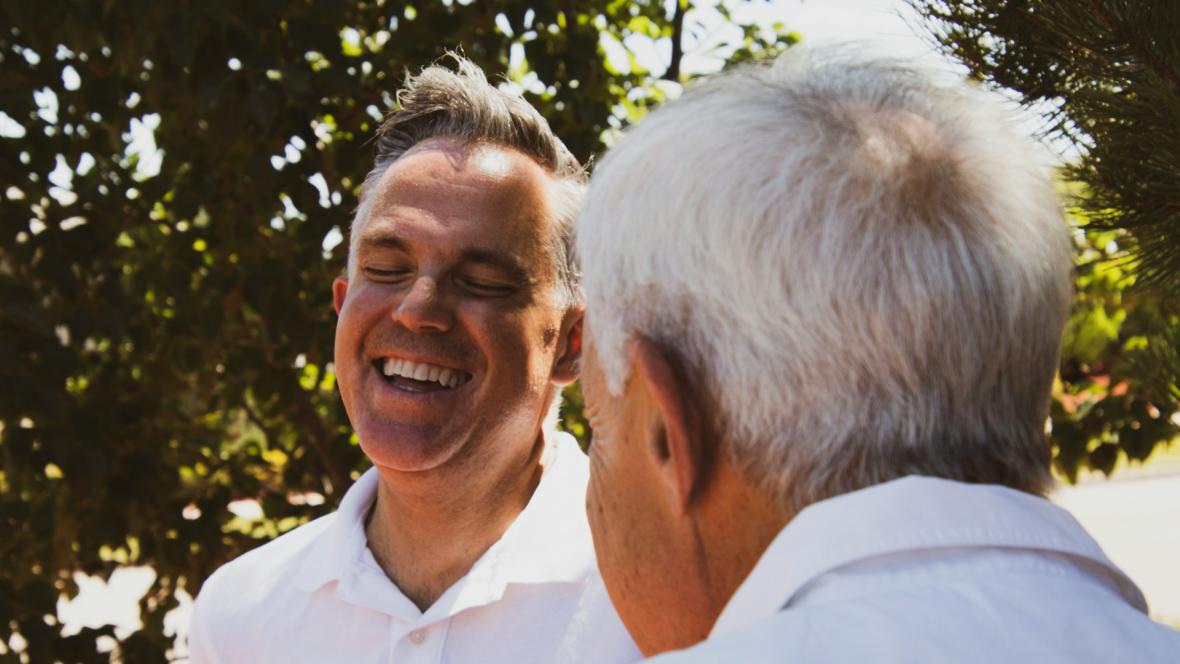
Humor, when it accompanies old age, creates community. It unites generations, dismantles stereotypes, and restores humanity to everyday life. A grandson laughing with his grandmother, a group of friends joking about their gray hair, an older man turning his ailments into anecdotes: all of them transform fear into affection.
Because, in the end, growing old with humor is not a strategy for looking young: it’s a way of staying alive, of making peace with time without submitting to it.
The Smile as Heritage
Humor is also inheritance. Older generations pass on their laughter the way they pass on their recipes, songs, or stories. A shared joke can last longer than a photograph: it contains complicity, memory, and affection.
Growing old with humor is not denying reality; it’s interpreting it with a bit lighter. And in that interpretation, humor becomes a form of wisdom. Those who know how to laugh at themselves have understood half the mystery of life.
When was the last time you laughed at yourself without caring about the passing of time?
¿Quieres que te recomendemos más artículos en base a tus lecturas anteriores?