Talent Doesn't Retire: Let's Reclaim Senior Knowledge and Creativity
Traducir artículo
¿Quieres un resumen de este artículo?
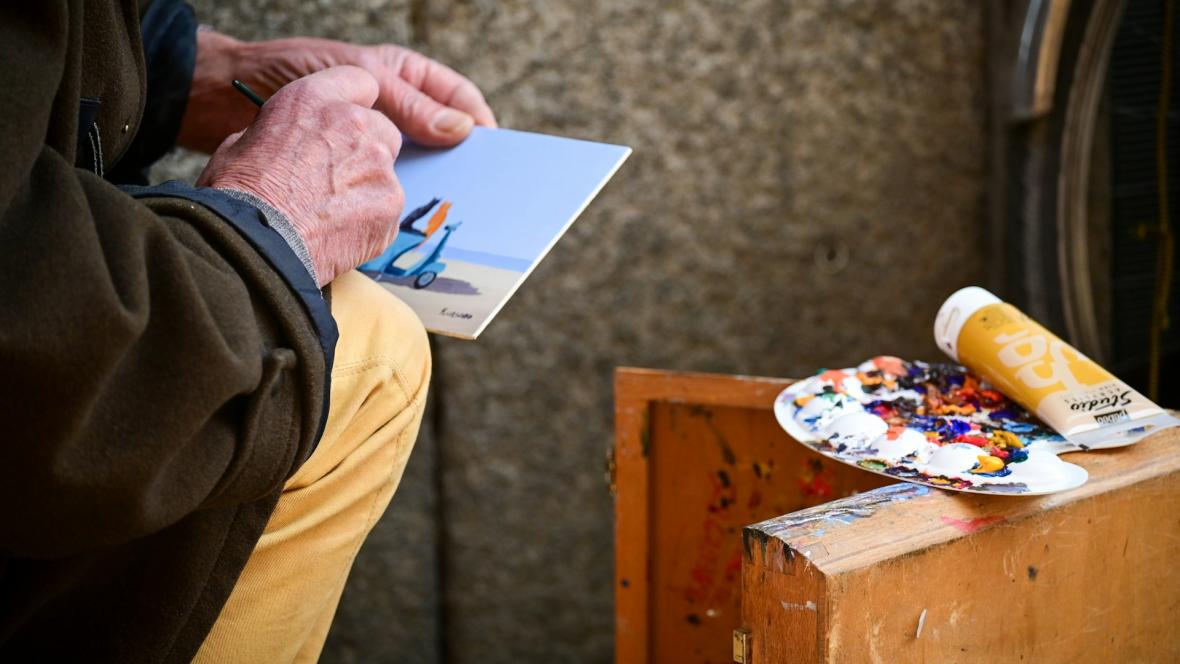
In a room at the International Spanish Center in Salamanca, some vases, a bicycle, and a log emerge from the paintings of Félix Felmart. They not only evoke rural memory but also pose a direct question to those who view them: why do we continue to measure talent with the everlasting yardstick of youth? The exhibition Talent Has No Age, promoted by CENIE and the General Foundation of the University of Salamanca, is both a tribute to the beauty of lived experience and a challenge: how much do we lose when we ignore the wealth of wisdom, creativity, and experience that older people possess?
We live in a world that glorifies novelty, innovation associated with youth. Talent, in this mindset, seems to have an expiration date: after 50—or even earlier—people stop being hired, invited, listened to… Yet, it's demonstrated that this stage of life is precisely when experience, perspective, and depth can reach their greatest splendor, as a result of all that has been lived, learned, and experienced. The artist from Salamanca himself says: “I paint what I've lived and what I still remember. Age doesn't take away my creativity; on the contrary, it gives me depth.” This simple yet powerful statement embodies a truth long advocated from various fields.
The association between youth and creativity runs deep—not only in popular culture but also in academia and business. According to data from Fundación Adecco, 62% of unemployed people over 55 are long-term unemployed, and 75% believe they won't return to the market, seeing their age as an obstacle to finding employment. Spain, along with Italy, has the highest unemployment rates among people aged 55 to 69 in the European Union, according to the II Senior Talent Map published by Fundación Mapfre’s Ageingnomics research center.
Despite the aging active population, 40% of Human Resources managers admit to automatically discarding resumes from applicants over 55, according to data from the Senior Talent White Paper by Fundación SERES and Fundación Adecco. These statistics are denounced by experts who urge their reversal as alarming and unsustainable, also for reasons of economic efficiency and profitability. “There will be a talent war. We will need key skills and competencies. Companies' challenge is making these people employable until retirement,” warned Elena Cascante, president of the Generation and Talent Observatory, in an article. Similarly, Manel Fernández Jaria, collaborating professor at the UOC's Economics and Business Studies, warned, “for a long time, it was believed that senior talent wasn't useful, but this will change.”
Wasting senior talent is not only a personal injustice but also a collective economic loss. The World Bank and OECD have repeatedly warned that the labor and social exclusion of older people entails a direct cost to productive systems. In an aging country like Spain—where more than 30% of the population will be over 65 by 2050, a frequently repeated figure—it's contradictory to maintain labor structures that exclude or undervalue those with the most experience.
Beyond unemployment figures and macroeconomic data, it's worth reflecting more deeply on what talent represents and what age adds to it. Economist David Galenson, a professor in the Department of Economics at the University of Chicago and a research associate at the National Bureau of Economic Research, is known for proposing a new theory of artistic creativity. He distinguishes between two different types: conceptual creativity (more common among young people, associated with groundbreaking ideas) and experimental creativity (more common among older people, who perfect their art over time). Picasso and Mozart exemplify the former; Cézanne and Beethoven, the latter. One of Galenson's ideas, explained in his book Old Masters and Young Geniuses, is that some people produce their best work early in their careers; others, after decades of exploration and maturation.
As Galenson explains, Cézanne's most expensive paintings are those he painted in the year of his death, at age 67. Cézanne is the third most represented French artist of the 20th century, yet of all his reproduced images, only 2% are from his twenties. He completed 60% after turning 50, and more than a third during his sixties. Can we afford to undervalue, underestimate, or ignore senior talent and thus miss out on tremendous capabilities like those of Cézanne, which flourish in life's later stages?
The problem is not only economic but also social and cultural. “We remain heavily conditioned by stereotypes associating youth with talent or creativity,” noted Óscar González Benito, director of the University of Salamanca Foundation, during the exhibition's opening. Photographer Luis Malibrán suggested a revealing key: it's not just what we look at, but from where we do it. Senior talent, often invisible or blurred in social narratives, requires another approach. Rather than a new perspective, an old one that must be recovered.
Building long-lived societies demands more than prolonging life. It demands transforming our perspective. Talent isn't just sparkle or novelty: it's also substance, vision, and patience. And that isn't improvised; it's cultivated, lived, and shared. Recognizing senior talent isn't a generous concession to those who've “already contributed.” It's an urgent necessity if we want sustainable, diverse, and truly intelligent societies. Talent doesn't retire; it just waits for someone brave enough to see it as it deserves.
¿Quieres que te recomendemos más artículos en base a tus lecturas anteriores?