
Sidelining the Human, Imposing Technology: A New Social Model
Traducir artículo
¿Quieres un resumen de este artículo?
Quite a few years ago (though it feels like yesterday, which makes me think about the relativity of time), I wrote on this blog about how many technologies — supposedly designed to make our lives easier — end up shifting both the work and the responsibility for using them onto the people who use them (the post is here, if you want to read it). I started from an everyday example: bank tellers being replaced by ATMs, and the way that, when something went wrong, the user's competence was what came under scrutiny. ATMs also change our social relationships: we no longer need to say good morning in order to withdraw our own money. The work changes hands (there is no longer a person earning a salary to help someone else with their banking), and everyday social relationships change too. Another example of that shift in labor is what happens when we weigh our own fruit at the supermarket and then scan and pay for our own groceries at self-checkout.
In these cases (and in so many others), technology does not necessarily eliminate tasks; it simply changes who performs them. My sense is that this logic has not only taken hold, but has become deeply normalized. Younger generations no longer have to ask the butcher how they want their steaks cut; the steaks already come pre-cut, wrapped in single-use plastic. They do not need to wait their turn at the fruit counter, nor will they be able to ask the person at the deli counter which cheese would be best for a sandwich.
We hardly even think about it anymore.
We have grown used to doing, on our own, an enormous number of everyday micro-tasks that only a few years ago were distributed differently. We book appointments, deal with delivery problems involving packages brought by couriers we never see and sent by people we have never spoken to. We also handle bureaucratic tasks and all sorts of other matters that require us to remember endless passwords, verify our identity, prove to a machine that we are not a robot, constantly learn new interfaces, or solve technical problems that appear in the middle of ordinary daily life.
All of this is usually sold to us through a very specific story: convenience, autonomy, innovation, efficiency. The password part alone (“that one doesn't work; neither does that one”) causes me more inconvenience than having to talk to the butcher and keep Paca from apartment 3C from cutting in line. But in reality, no one gives me that option anymore.
Maybe we should stop and ask a central question: for whom is this way of organizing everyday activities actually convenient? I will say it again: I have serious doubts that my life is more convenient now. I am certain it is not simpler. But sometimes I get the feeling that you are not allowed to say out loud that so much automation makes you uncomfortable. That it does not feel like progress. That it takes more from us than it gives. That everyday human contact has disappeared, and that younger generations no longer know how to handle certain interactions because they do not need to. Until they do.
Perhaps one of the more interesting things — I am not sure that is the right word — about aging is that it makes visible many points of friction that the rest of society still manages to keep out of sight. When an older adult hesitates at an ATM, takes longer to complete an online process, or needs help using an app, an apparently obvious explanation quickly appears: “they don't know how to use technology.” That person is being blamed for bad design, but at the same time it brings a problem into view: this thing we are being told is wonderfully convenient and has come to simplify life is not, and it does not simplify life for everyone.
The point is that perhaps (being generous) we are not looking at an individual deficit, but at systems built on extremely narrow assumptions about the abilities of the people who use them. But bodies, rhythms, and ways of approaching everyday problems matter. As if we were much more alike than we really are.
Contemporary technology seems designed for people who are permanently available, cognitively agile (very agile, in fact), able to keep learning new interfaces and ready to adapt constantly to technological change. People with good vision, good motor skills, available time, and enough confidence to solve any digital problem without too much difficulty. I suppose it is obvious that real life is not like that; it does not work that way. And perhaps, trying to be positive here and making a rather large conceptual leap, old age is precisely what allows us to remember this.
That not all of us can do everything. That not all of us can keep adapting to permanent change. That it is not, or not only, a matter of being able to absorb the new; there are other issues we need to take into account, and they do not depend on the user. That arthritis in the hands, which can make using a tablet impossible, cannot be solved by individual effort (if only), and that technologies are not all-powerful. Nor should they be. That there is something we might call technological vulnerability, and that it forces us to rethink what kind of society we are creating, who we are leaving out, and what we are getting in return for all this.
In reality, we all go through moments of technological vulnerability over the course of our lives: illness, motherhood, intense caregiving, stress, grief, or simply everyday exhaustion. The difference, perhaps, is that old age makes structural something that the rest of us can still experience as temporary.
This makes me think that there are moments when any apparently simple process (filing a tax return, for example, when something is even a little more complex than usual) becomes an enormous burden. And that (perhaps) this whole matter of old age and older people (the others, of course) works in this context as a future mirror of our own dependencies.
We have run away from personal interdependence (on the path toward supposed self-sufficiency), but we are deeply dependent on technology. Yet once this dependence has been imposed without alternatives, we treat the inability to adapt as an individual failure. I want to insist on something I already said in the post I mentioned at the beginning: in any other field, if a product did not work properly for a significant share of the people who have to use it, we would probably revisit the product's design.
If no one can open a door, the problem is with the door. With technology, however, something strange happens: we take for granted that the problem is always with the person who cannot adapt fast enough.
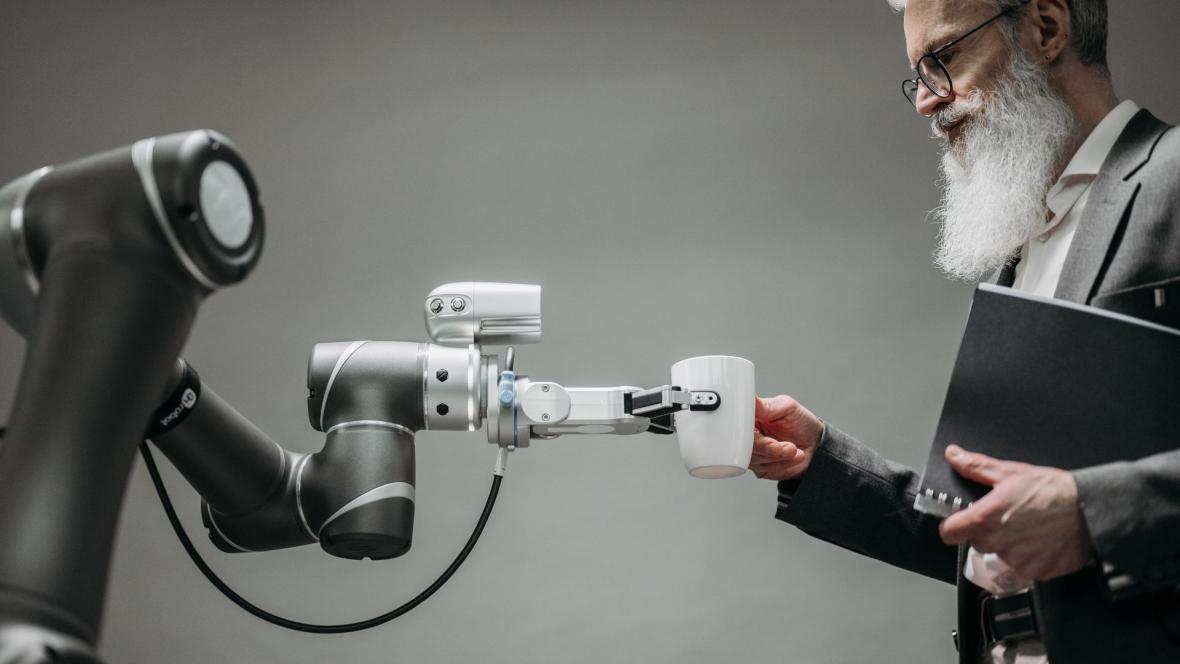
Yet many technological solutions aimed at older adults start from a very specific idea of autonomy. Sensors, apps, robots, virtual assistants, and monitoring systems promise independence in old age. But we rarely ask ourselves what exactly that independence means. Are we confusing autonomy and independence with having no ties, or with not needing human help? Could it be that we treat depending on other people as a failure, while validating dependence on technology? Was it really a problem to depend on the person who weighed your fruit at the supermarket?
I am not sure I like this model of dependence, to be honest. Perhaps, more than the technological problem itself, we need to think about the form of social organization we have normalized and whether it truly serves us.
Perhaps we should also ask ourselves why we are building a world that demands so much constant adaptation simply to take part in everyday life, and who benefits from this system.
Perhaps this new social model, so dependent on technology and so detached from human beings, is not as positive as we had led ourselves to believe.
¿Quieres que te recomendemos más artículos en base a tus lecturas anteriores?